
The Wall Street Journal’s Saturday/Sunday edition on January 4, 2025 had an article in the Eating and Drinking section entitled The New Flour Power. When Jack read the article he paid me a compliment..He was surprised and pleased that I had picked up on something that he would later read in the paper . He remarked “Well, you were ahead of the curve, I’m impressed!” The article was about professional and even occasional bakers like me using wheat flour milled by local millers using wheat from local farmers.
This summer on a trip to France, we spent a few days in Bordeaux. The first day as we explored the city with a long walk, we stopped for lunch at a local restaurant. It wasn’t a fancy or expensive place, just a place for locals (and hungry tourists like us) to have a quick lunch. Although the table was set with a paper table “cloth” and the bread basket was a little metal bucket, the meal was delicious.

What I noticed was the odd color of the bread, which had a marked crust and a tender, light crumb.
Then I noticed that all the bread that was served with our meals had a distinct color and a nutty flavor. What was going on? Wasn’t there is “normal” bread to be had in Bordeaux, maybe a crusty baguettes? As soon as I got back home I asked my search engine the question “Why is bread in Bordeaux reddish?” and found that yes, indeed, there was something distinct about the flour in Bordeaux, and the eponymous name for this hard red winter wheat is Rouge de Bordeaux.
We all have a mental image of France with someone walking down a picturesque street with a fresh baked baguette under their arm or in cute basket, maybe with a bunch of flowers poking out along with the baguette! However, exactly when baking bread in the shape of a baton originated is open for a bit of discussion, but, it was around the time of the napoleonic wars. As to where baking baguettes originated, some want to say that it was first baked in Bordeaux and, you guessed it, using Rouge de Bordeaux flour. Well, let’s just say that is what happened!
It had been several years since I had routinely baked bread. Inspired by the novelty of a wheat flour I had never heard of, I decided that not only did I want to get back to baking bread, but that I would want to use flours that came from small local farm, à l’ ancienne, and I began to look for places I could buy Rouge de Bordeaux. Not as easy as all that, but after a couple of tries I located an Ohio company called Local Millers which sells stone ground flour from local farms. I placed an online order with them and soon the bag of flour arrived. Ok, that was the easy part. (click on Local Millers and you will see a link to their website)
I decided to plunge in, simply substituting Rouge de Bordeaux flour in my bread recipes and see what happened. The latest bread I have tried is a rustic bread inspired by a bread we had at in Hostelerie Le Phebus in Joucas, a small town in the Luberon region of France. It is a whole wheat bread that has walnuts, walnut oil, and a bit of honey. The results are much better than when I have baked it before using commercial whole wheat bread. The crumb of all three breads that I have baked using Rouge de Bordeaux have a wonderful texture and the flavor is nutty whether you use nuts in the recipe or not…
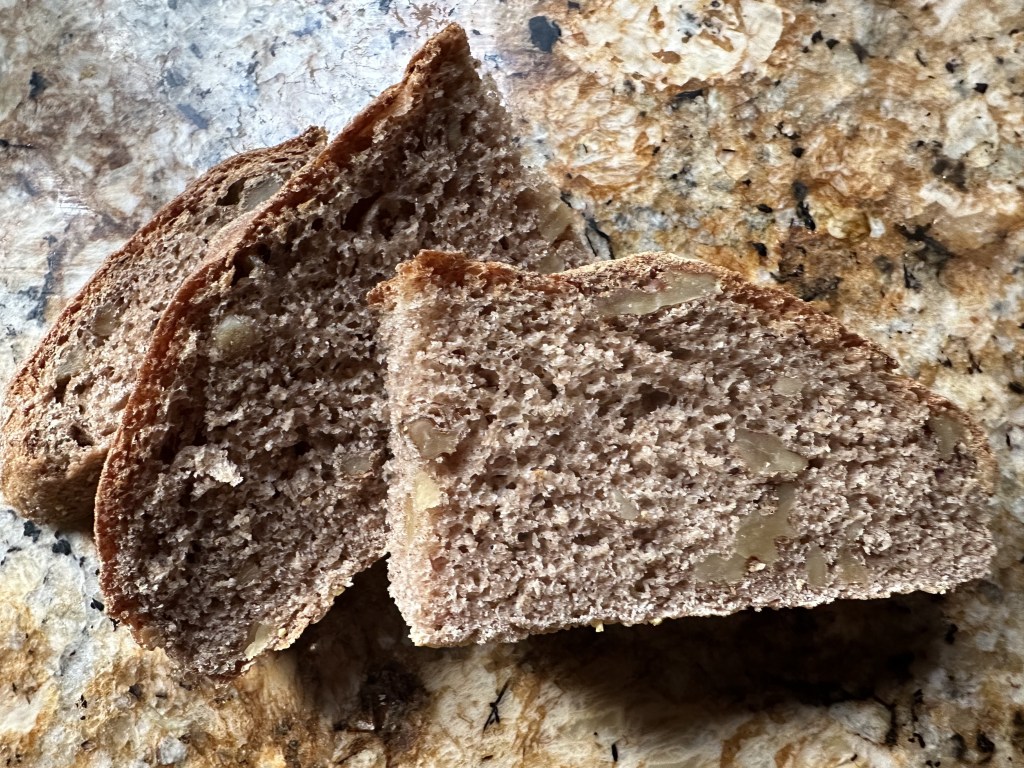
These are slices of the walnut bread I cooked using Rouge de Bordeaux, with its pronounced crust and reddish brown color.
A recipe will soon follow!
 My Mom Likes to Cook